E-mail: email@fusonwindoor.com | Tel: +86-189-2593-0732
 English
Views: 0 Author: Site Editor Publish Time: 2026-07-03 Origin: Site
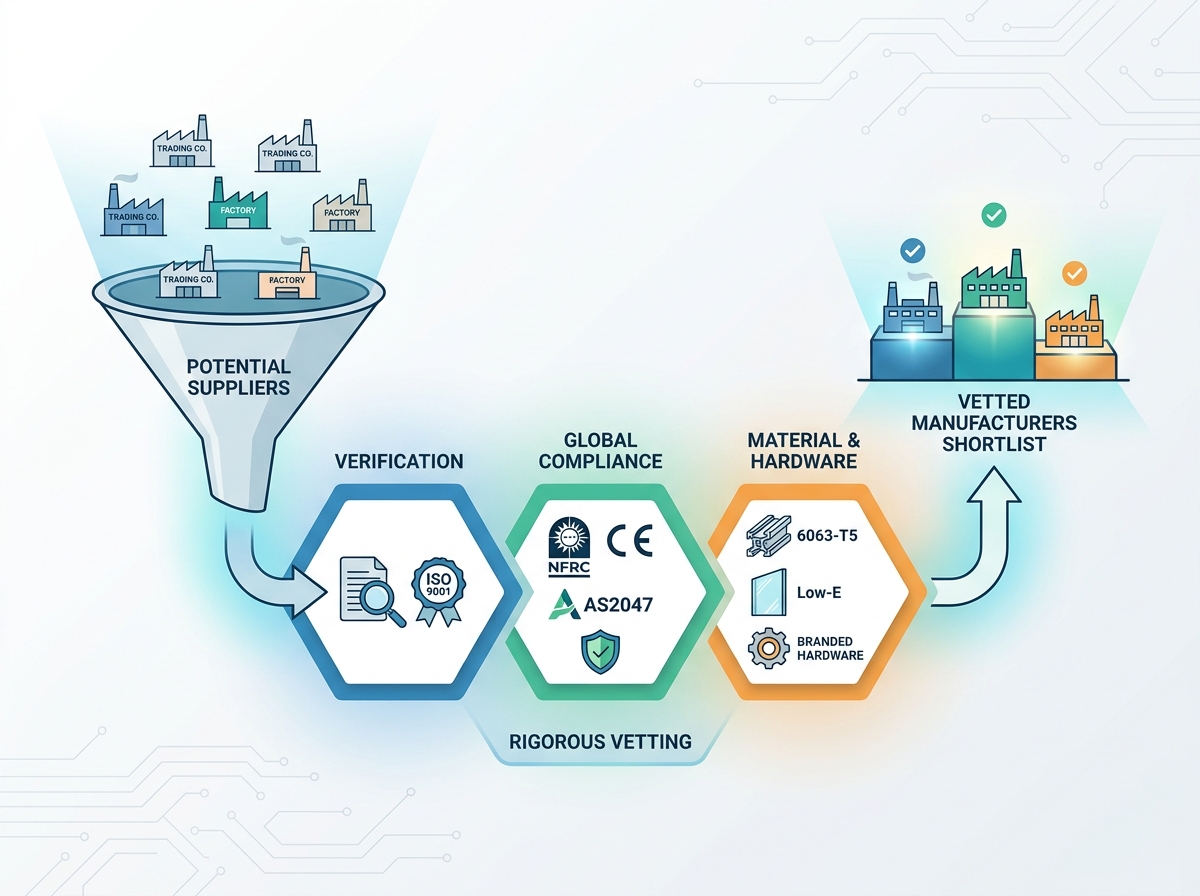
Sourcing fenestration for major developments demands extreme precision. Procuring from an aluminum window manufacturer china wholesale presents a high-stakes challenge for overseas developers and contractors. Balancing cost-efficiency alongside stringent local building codes—such as NFRC, CE, and AS2047—requires rigorous supplier vetting. You cannot rely on trading companies acting as mere intermediaries. Instead, you need direct manufacturers possessing proven export track records. Selecting the wrong partner often leads to severe supply chain bottlenecks and failed site inspections.
We provide an objective look at the top tier of Chinese extrusion and fabrication factories. You will discover a decision-ready shortlist based on production capacity, compliance infrastructure, and material grade. We also detail a practical framework. It will help you evaluate your own specific project needs. You will learn how to bypass common procurement traps and secure high-quality fenestration systems. Read on to guarantee global compliance and ensure seamless project execution.
Global compliance (NFRC, CE, AS2047) and third-party testing are non-negotiable baselines for overseas projects, not premium add-ons.
The effectiveness of a thermal break profile depends heavily on the manufacturer's extrusion precision and polyamide strip sourcing (e.g., Technoform).
Factory selection should align with project scale—commercial high-rises require different fabrication capabilities than luxury residential builds.
Understanding MOQs, hardware partnerships (e.g., HOPO, Siegenia), and lead time realities prevents costly supply chain bottlenecks.
Evaluating overseas suppliers requires a structured approach. We look far beyond basic marketing brochures. A reliable manufacturer must demonstrate robust operational capacities across multiple disciplines.
Identifying true factories is your first critical step. Trading companies often disguise themselves as manufacturers. They mark up prices and lack direct quality control. We vet suppliers via rigorous production line audits. We examine their in-house extrusion capabilities. Legitimate factories hold current ISO 9001 certifications. They also employ dedicated engineering teams to handle complex architectural drawings.
Building codes vary wildly across the globe. Your supplier must provide verifiable testing reports. We look for AS2047 certifications for the Australian market. We demand NFRC ratings for North American projects. We require CE marks for European developments. Unverified certificates often lead to rejected shipments at customs. Always cross-reference testing documents directly through the issuing third-party laboratory.
The core strength of any window lies in its materials. We assess primary aluminum billet purity. Top manufacturers strictly use 6063-T5 or 6063-T6 alloys. We actively disqualify factories relying heavily on recycled scrap aluminum. Scrap compromises structural integrity and finish adhesion. We also evaluate their glass suppliers. Reliable partners use SGCC-certified glass featuring advanced Low-E coatings.
Hardware failures destroy otherwise excellent windows. Sourcing reliability depends heavily on hardware ecosystems. We check if the factory utilizes genuine imported hardware. Brands like Roto, Siegenia, and GU indicate high quality. High-tier domestic brands like HOPO also offer excellent performance. A manufacturer must prove they purchase these components through authorized channels.
Evaluation Pillar | Baseline Requirement | Premium Indicator |
|---|---|---|
Facility Type | ISO 9001 certified assembly | In-house extrusion and automated CNC lines |
Compliance | Local market basic testing | Verified NFRC, CE, or AS2047 certificates |
Aluminum Alloy | Standard 6063-T5 billet | Virgin 6063-T6 billet exclusively |
Hardware Partners | Standard domestic hardware | Authorized Siegenia, Roto, or HOPO usage |
Best Practices: Always request unredacted test reports. Compare the listed factory name against the company you are actively paying. Discrepancies usually indicate a trading company setup.
We applied our rigorous evaluation criteria to the Chinese fenestration market. The following shortlist highlights factories excelling in specific project categories. You should match your project requirements to their specific strengths.
Core Strength: Scale, automated production lines, and high-capacity output. They handle massive orders effortlessly.
Target Projects: High-rise condominiums, hotels, large commercial developments.
Key Certifications: Verified CE marking and ISO 14001 environmental certification.
Potential Trade-offs: They maintain higher MOQs. You will find less flexibility for bespoke residential designs.
Core Strength: High-end finishing, complex architectural configurations, precision engineering. They excel at unique shapes and oversized panels.
Target Projects: Custom villas, luxury residential, specialized architectural retrofits.
Key Certifications: NFRC compliance and SGCC certified glazing partnerships.
Potential Trade-offs: Expect a premium pricing tier. Custom tooling requirements often create longer lead times.
Core Strength: Advanced insulation technology integrates a multi-chamber thermal break profile seamlessly. They offer triple glazing as a standard option.
Target Projects: Extreme climate zones, LEED-certified buildings, passive houses.
Key Certifications: Verified NFRC low U-factor reports and European passive house institute testing.
Potential Trade-offs: They offer a narrower product catalog. Their focus remains strictly on high-performance models.
Core Strength: They boast an established dedicated export division. You benefit from streamlined OEM/ODM processes and strong logistics support.
Target Projects: Mid-market residential developments, mixed-use commercial properties.
Key Certifications: AS2047 verified testing for the Oceania market.
Potential Trade-offs: They may outsource certain specialized glass treatments to nearby partner facilities.
Core Strength: They deliver a unified aesthetic across diverse product lines. You can source windows, bi-folds, and curtain walls under one cohesive system.
Target Projects: Large-scale projects requiring consistent design language across all fenestration elements.
Key Certifications: Comprehensive ISO 9001, CE, and comprehensive localized testing validations.
Potential Trade-offs: Their broad manufacturing focus might mean they are not the absolute cheapest option for a single standard window type. However, they provide immense overall project value.
Selecting the right factory only solves half the puzzle. You must also specify the correct window profiles for your building's architectural demands. Different profiles require completely different engineering tolerances.
An aluminum sliding window is best for space-constrained residential balconies and commercial partitions. They slide parallel to the wall, requiring zero interior or exterior clearance. Space-saving designs make them incredibly popular in urban high-rises.
Evaluation check: Look carefully for heavy-duty bottom rollers. Ensure the factory uses multi-point locking mechanisms. These features guarantee high wind-load resistance and prevent rattling during severe weather.
A casement window china remains the standard for maximum ventilation and unobstructed views. They crank outward or push open entirely. This design catches passing breezes and directs airflow into the building interior.
Evaluation check: Friction stay hinge quality is absolutely critical. Poor hinges cause heavy sashes to sag over time. This creates extreme safety hazards in high-rise applications. Demand heavy-duty stainless steel hinges for any operable sash exceeding one square meter.
A tilt turn window offers a European-style dual-function design. They tilt inward at the top for secure, rain-proof ventilation. They also swing inward out of the frame for incredibly easy cleaning.
Evaluation check: This complex mechanism requires ultra-precise CNC machining. The factory must install premium multi-point hardware accurately. Any misalignment during fabrication will cause operational failure over time. Always ask for operational cycle testing data.
Common Mistakes: Do not specify sliding windows for areas demanding maximum acoustic insulation. Casement and tilt-turn systems naturally provide superior compression seals against noise transmission.
Procuring overseas materials involves managing physical logistics alongside product quality. You must understand how manufacturers handle minimum orders, surface treatments, and container loading. Ignoring these realities leads to broken glass and corroded frames.
Factories do not spin up production lines for tiny orders. Standard industry MOQs typically range from 50 to 100 square meters. You must negotiate trial orders strategically. Frame these initial small batches as mock-ups for a larger upcoming phase. Once the factory verifies your project scope, they usually accommodate a smaller initial run before committing to bulk manufacturing.
Surface treatments dictate how long your windows survive the elements. Standard powder coating works fine for inland projects. However, coastal developments face severe salt-air corrosion. Fluorocarbon (PVDF) or premium AkzoNobel powder coating is essential for these harsh environments. PVDF coatings resist fading, chalking, and blistering much longer than standard finishes. Always verify the coating thickness using a specialized micrometer during inspections.
Ocean transit is brutal on fragile goods. Poor packaging guarantees glass breakage. Top-tier factories use sealed wooden crates and custom iron pallets. They wrap frames in protective film to prevent scratching. Strategic container loading uses airbags and heavy-duty strapping. This prevents cargo from shifting during rough seas. You should mandate photographic proof of container loading before authorizing your final payment.
Best Practices: Specify ISPM 15 compliant fumigated wooden crates. Customs officials will reject and quarantine containers using untreated wood, causing massive delays.
A vague request generates an inaccurate quote. Manufacturers base their pricing strictly on the details you provide. You must build a highly detailed Request for Quotation (RFQ) to get realistic numbers.
Do not simply ask for a "price per square meter." Exactly what you provide the manufacturer determines your success. You must include:
Complete architectural elevations showing exact dimensions.
Local U-value and Solar Heat Gain Coefficient (SHGC) requirements.
Specific wind load calculations for your building height.
Explicit hardware brand preferences and opening configurations.
Required glass specifications (thickness, tempering, tints, and inert gas fills).
Clear RFQs signal professionalism. Top factories prioritize detailed requests over vague emails.
Never skip the physical prototype. Why should you always demand a physical corner sample or full-size mock-up? It allows you to verify corner joint sealing directly. You can inspect the thermal break alignment physically. You can test the hardware operation before authorizing mass production. A mock-up serves as your golden standard. You hold all bulk production accountable against this exact physical sample.
Trust, but verify. Engaging independent inspection agencies guarantees peace of mind. Hire firms like SGS or TUV for pre-shipment quality control (QC). These inspectors visit the factory on your behalf. They check dimensions against approved shop drawings. They test water tightness on random samples. They oversee the container loading process. The minor cost of an inspector prevents the catastrophic cost of receiving defective materials overseas.
Partnering with a vetted Chinese manufacturer yields significant project cost advantages. However, this success strictly depends on a disciplined procurement strategy. Your evaluation must remain firmly anchored in compliance, material quality, and verifiable factory capabilities. Do not sacrifice structural integrity for minor upfront savings.
Take actionable steps today to secure your supply chain. Build a comprehensive RFQ using the guidelines above. Reach out to verified manufacturers to request their latest technical catalogs. Submit your architectural drawings for a detailed, itemized quote. Better yet, schedule a virtual factory tour to inspect their production lines directly. Proactive vetting ensures your next major development features flawless fenestration.
A: Expect 30 to 45 days for manufacturing. You must also add 20 to 30 days for ocean freight. Custom extrusions increase this timeline. Standard profiles usually ship much faster. Always factor shipping variables into your master construction schedule.
A: Yes. Reputable factories offer standard 5 to 10-year warranties covering hardware and profile integrity. You must document these terms explicitly in your commercial invoice. Keep in mind, honoring a warranty overseas usually involves shipping replacement parts rather than dispatching labor.
A: Never accept a simple PDF certificate at face value. Advise checking directly with the issuing third-party laboratory. You should request the full, unredacted test report. Cross-reference the factory name, product series, and testing dates through the laboratory's official online portal.
A: Yes. Top manufacturers offer comprehensive RAL color matching capabilities. Custom powder coating requires specialized mixing and separate line runs. This process typically adds 10 to 15 days to your overall production lead time. Always approve a physical painted metal swatch before full production.