E-mail: email@fusonwindoor.com | Tel: +86-189-2593-0732
 English
Views: 0 Author: Site Editor Publish Time: 2026-07-04 Origin: Site
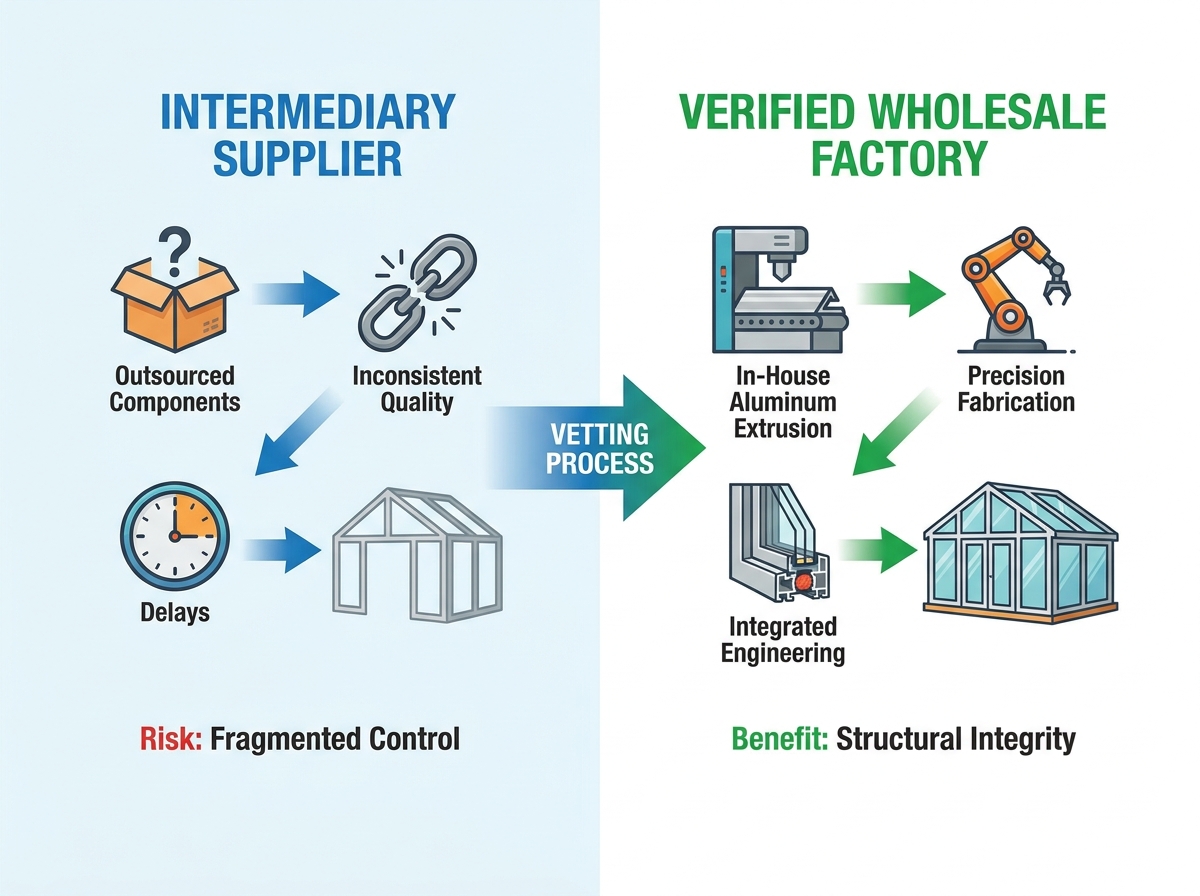
Sourcing sunrooms at scale requires moving beyond aesthetic product catalogs. You must evaluate the actual production capabilities of a manufacturer closely. Taking a surface-level approach often creates huge risks for large construction projects. Partnering with the wrong supplier leads to expensive project delays. It also causes mismatched tolerances on-site and severe building code compliance failures. You must identify a true manufacturing partner rather than a middleman. A reliable wholesale sunroom supplier factory will provide transparent data. They deliver clear facts on structural integrity, material sourcing, and supply chain logistics. This article provides a standardized evaluation framework for your business. We will help contractors, distributors, and project managers vet manufacturers properly. You will learn how to shortlist sunroom partners based on operational realities instead of just flashy marketing claims. This ensures your next large-scale installation proceeds smoothly and profitably.
Prioritize factories with in-house extrusion and fabrication to ensure strict tolerance control for every aluminum sunroom frame.
Demand documented thermal and structural engineering capabilities, especially when sourcing a four season sunroom for extreme climates.
Assess the supplier’s material versatility, ensuring they can produce both a traditional glass sunroom and a lightweight polycarbonate roof sunroom.
Verify scalable production capacities, transparent lead times, and robust B2B technical support (including CAD drawings and warranty backing).
True factory suppliers control the entire metalwork process. You should look for in-house cutting, milling, and finishing. This level of control guarantees the quality of every aluminum sunroom frame. Suppliers who merely assemble outsourced components often suffer greatly. They experience highly inconsistent quality control. They also face severe supply chain bottlenecks during peak construction seasons.
Why does in-house extrusion matter so much? It maintains strict manufacturing tolerances across every batch. A gap of just two millimeters can cause severe water leaks. You need precision engineering for structural stability. Extrusion involves pushing hot aluminum through a custom steel die. Factories controlling this exact step guarantee structural consistency. You avoid mismatched parts during job site installation. This speeds up your crew's daily workflow significantly. Advanced factories also use computer numerical control (CNC) machines. CNC technology ensures every cut matches the blueprint perfectly.
The supplier must also demonstrate high-performance climate engineering. They need to show proven thermal break methods. They must also document robust condensation control systems. If you supply a four season sunroom, the factory needs specific structural profiles. These heavy-duty profiles must accommodate double or triple-pane insulated glass. They must also integrate advanced polyamide thermal barriers.
What exactly is a thermal barrier? It physically separates the interior aluminum from the exterior profile. This stops cold heat transfer entirely. Without it, extreme winter temperatures freeze the interior frame surfaces. You will face angry clients demanding repairs. Ask suppliers for their Condensation Resistance Factor (CRF) test results. They must meet regional building codes for extreme climates consistently. A well-engineered thermal break prevents interior sweating entirely.
Comprehensive glazing options indicate a highly capable manufacturing partner. The factory needs the ability to serve different market tiers. They should offer high-performance Low-E, argon-filled glass units. This specific material serves premium builds like a standard glass sunroom perfectly. Argon gas acts as an invisible insulator between the glass panes. It blocks unwanted heat loss during cold winter months.
They should also provide UV-coated, multi-wall plastics. This material creates a highly cost-effective polycarbonate roof sunroom for budget-conscious projects. Polycarbonate filters harmful UV rays while letting natural light enter. It resists yellowing over decades of sun exposure.
Look for suppliers who transparently share their energy efficiency ratings. Ask for the U-factor and Solar Heat Gain Coefficient (SHGC). These numbers prove the real-world performance of their glazing partnerships.
Feature Dimension | Premium Insulated Glass | Multi-Wall Polycarbonate |
|---|---|---|
Thermal Insulation (U-Factor) | Excellent heat retention | Moderate heat retention |
Weight and Handling | Very heavy, requires equipment | Lightweight, easy manual lifting |
Light Transmission | High clarity and visibility | Diffused light, reduces glare |
Impact Resistance | High (tempered requirements) | Extremely high, shatterproof |
Product lines require documented wind and snow load testing data. You must request stamped engineering reports. Verify standard kits meet or exceed regional building codes. Look for IBC, IRC, or local county equivalent standards. Wind uplift can easily destroy poorly engineered structures. Heavy snow loads can collapse weak roofs overnight. A trusted partner provides stamped structural calculations readily. They remove complex guesswork for your local permitting process. This evidence-oriented action protects your business liability.
Scalable production capacity defines a true wholesale partner. Assess the factory’s absolute maximum monthly output closely. Check their Minimum Order Quantities (MOQs) for custom extrusions. A dependable partner provides clear Service Level Agreements (SLAs). These clarify manufacturing lead times during peak construction seasons. They also outline off-peak scheduling benefits. You need guarantees regarding volume scale-ups.
Sunroom components remain highly susceptible to heavy transit damage. You must evaluate their specific crating methods thoroughly. Look for heavy-duty wooden crates securing all heavy components. They should use specialized A-frames for large glass panels. They must stage and package hardware separately. Proper weight distribution inside shipping containers prevents tipping.
Follow these essential steps to audit packaging protocols:
Audit the glass crating process for integrated A-frames.
Inspect corner protection methods on all extruded profiles.
Verify hardware separation techniques to prevent transit scratching.
Confirm external crate banding meets international freight standards.
Poorly packaged shipments lead to massive on-site delays. Contractors might discover completely shattered glass upon arrival. They might find bent extrusions during the unpacking phase. This ruins project timelines and destroys contractor profitability. You lose money waiting for replacement parts. Strong logistics prevent these costly on-site nightmares entirely.
Technical support separates great factories from average ones. Look for suppliers offering dedicated B2B account managers. Check for highly accessible CAD drawings for every model. Ask about direct installation training for your contractor crews. Real-time troubleshooting support saves hours of frustration.
You must review the warranty terms very closely. Distinguish between the external aluminum finish warranty and the glass warranty. Powder coating warranties cover eventual fading and chalking. Look for industry-standard AAMA 2604 or 2605 coating certifications. These standards involve severe environmental testing methods. They prove long-term weather resistance against harsh UV rays.
Insulated glass unit warranties cover internal seal failures. A seal failure causes ugly condensation between the glass panes. A ten-year seal warranty represents a standard industry benchmark. Consider anything less a serious red flag. Seal failures ruin the aesthetic appeal of the enclosure.
Your field installation teams need detailed shop drawings always. A true partner supplies clear CAD files proactively. They offer step-by-step physical assembly manuals. They often provide helpful video training resources too. This reduces expensive labor hours on the job site. It minimizes costly contractor errors during complex installations. Strong B2B support builds long-lasting business partnerships.
Narrow down your list to two or three factories initially. Base this decision on their load-testing documentation. Base it on their exact MOQ requirements for your scale. This shortlisting logic saves you massive evaluation time. Do not waste energy on suppliers lacking basic engineering reports.
You must request a comprehensive physical sample kit next. This kit should include assembled corner joints. It must have raw frame cross-sections and glazing samples. Physical samples reveal manufacturing truths immediately.
Evaluate these specific items inside the sample kit:
Clean extrusion cuts featuring zero burrs or sharp edges.
Tight corner joint alignments displaying absolute zero light gaps.
Uniform powder coating thickness across highly complex profiles.
High-quality weather stripping pre-inserted evenly along the tracks.
Audit a smaller pilot order first. Do this before committing to a long-term volume contract. This tests their real-world manufacturing and shipping speed. Verify their factory-direct pricing claims strictly. Compare the full landed costs of the product. Include base manufacturing, ocean freight, and potential import tariffs. Ensure the final numbers align perfectly with your budget. Test the elasticity of the weather stripping yourself. It should bounce back immediately after compression.
Sourcing from a verified manufacturer reduces downstream installation risks significantly. It protects your project profit margins effectively over time. Focus on strict structural control during your supplier evaluation. Value broad material flexibility for different client budgets. Prioritize logistical reliability to keep jobs on schedule. Outline your regional climate requirements today. Forecast your annual volume projections clearly for accurate pricing. Begin requesting detailed technical data sheets from shortlisted factories immediately.
A: Lead times typically range from four to twelve weeks. Custom architectural sizes usually require more time than standard kits. Seasonality heavily impacts this window. Spring and summer orders face peak production bottlenecks. Shipping logistics also add variability. Ocean freight adds three to six weeks. Always request a clear Service Level Agreement covering both production and transit times.
A: Yes, reputable factories offer robust OEM and ODM capabilities. They customize structural profiles for specific architectural needs. This process requires CAD drawing approvals before manufacturing begins. Customization often impacts Minimum Order Quantities (MOQs). Custom dies increase upfront costs slightly. However, they allow you to match exact client specifications seamlessly. Verify their engineering team handles bespoke structural calculations.
A: Factories rely on certified third-party engineering reports. They perform rigorous thermal modeling and structural stress tests. Standard kits undergo physical wind uplift and snow load testing. Engineers adjust profile wall thickness based on these results. You must provide your local code requirements upon ordering. The supplier then modifies internal reinforcements to ensure strict regional code compliance.