E-mail: email@fusonwindoor.com | Tel: +86-189-2593-0732
 English
Views: 0 Author: Site Editor Publish Time: 2026-07-12 Origin: Site
Green commercial architecture faces a fundamental conflict today. Builders rely heavily on aluminum for its structural necessity and incredible durability. However, this metal possesses an inherent high thermal conductivity. This creates a massive energy leak. Modern construction demands strict adherence to stringent green building codes. Mandates like LEED, passive house standards, and net-zero targets require an uncompromised building envelope. Standard commercial framing simply cannot achieve these strict certifications. We must bridge this severe gap between structural integrity and thermal compliance. Positioning the thermal break window as this mandatory bridge is critical. It delivers the immense strength developers need. It also perfectly satisfies modern energy regulations. In this article, you will learn exactly why standard frames fail. We will explore core performance benefits and adoption risks. Finally, you will discover how to evaluate suppliers effectively.
Performance: Thermal breaks disrupt conductive heat transfer, drastically lowering U-values to meet or exceed green building energy codes.
Risk Mitigation: Polyamide struts prevent interior condensation, protecting surrounding drywall and framing from moisture damage.
ROI & Value: While initial Capex is higher than standard aluminum, lifecycle HVAC savings and qualification for green building tax incentives offset the premium.
Supplier Cruciality: Vetting a reliable thermal break aluminum window supplier requires validating third-party thermal testing (NFRC/AAMA) rather than relying on manufacturer claims.
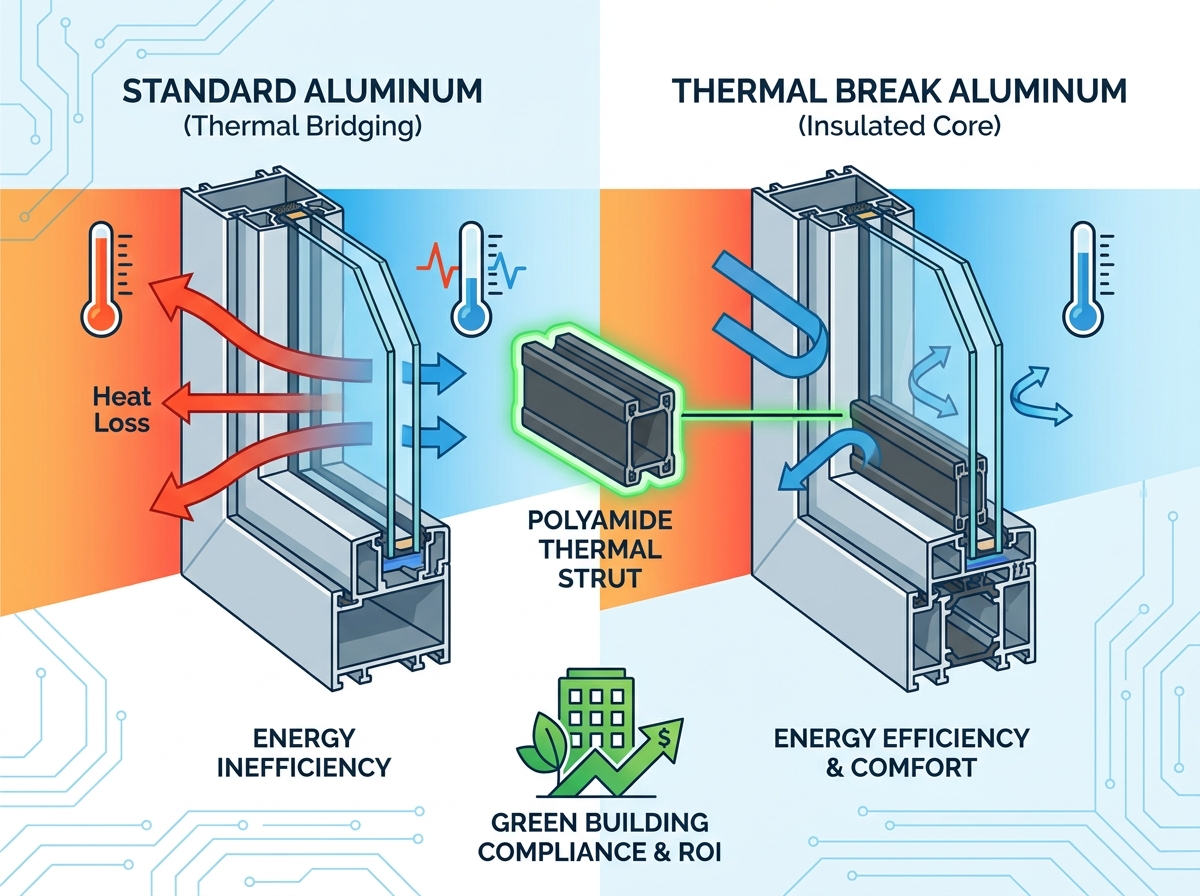
Continuous aluminum frames act as a dangerous energy sieve. They transfer exterior cold or heat directly into your building interior. We call this the thermal bridging problem. This physical phenomenon ruins the most carefully planned energy models. Heat follows the path of least resistance. Aluminum offers almost zero thermal resistance.
Standard frames fail modern energy codes completely. Guidelines like ASHRAE 90.1 set strict limits on energy transfer. Assessors measure this transfer rigorously. Older framing systems simply cannot pass these modern tests. They actively hinder a project from achieving LEED or BREEAM certification. Green building certification boards look closely at the building envelope. They will reject designs relying on outdated, unbroken metal profiles.
Assessors flag these weak points immediately. The lack of an insulated aluminum frame acts as a massive liability. It reduces overall building valuation significantly. It also destroys basic tenant comfort. People sitting near poorly insulated glass experience severe drafts. They feel the radiant cold during winter months. You lose valuable lease renewals. You face consistently higher HVAC loads. A robust barrier changes this entirely. We must prioritize occupant comfort alongside energy metrics.
Common Mistake: Ignoring framing U-values during the initial design phase. Architects sometimes assume high-performance glass alone guarantees compliance. It never does. You must address the frame.
Inserting a low-conductivity material separates the interior and exterior extrusions. Polyamide often serves this crucial role. It slashes the overall U-value of the entire system. This separation optimizes your Solar Heat Gain Coefficient (SHGC). It works perfectly alongside high-performance low-e coatings. You directly connect this improvement to reduced baseline HVAC load calculations. Systems run much more efficiently. You can downsize mechanical equipment safely.
Interior moisture control matters immensely. Condensation Resistance (CR) measures how well a surface prevents sweating. A high CR keeps mold risks far away. It maintains pristine indoor air quality (IAQ). IAQ acts as a critical metric for any green building window. Moisture accumulation rots surrounding drywall quickly. It damages expensive interior finishes. A proper thermal barrier eliminates this expensive risk completely.
Separating metal extrusions inherently dampens acoustic vibration. You gain powerful secondary soundproofing benefits. Urban green developments require strict acoustic insulation today. City planners demand quieter indoor environments. This synergy blocks traffic noise effectively. The polymer strut breaks the sound wave transmission path.
Aluminum boasts high recyclability and a long lifespan. It easily lasts over forty years. The thermal break makes it truly sustainable. You avoid the frequent replacement cycles common to vinyl alternatives. Vinyl degrades under intense UV exposure. Aluminum maintains its structural integrity. This dramatically lowers the embodied carbon of your facade.
Let us briefly contrast the two primary methods. Creating this barrier requires precision engineering. Understanding these methods demonstrates true technical expertise.
Polyamide thermal struts represent the modern industry standard. Commercial green buildings demand them exclusively. They offer superior structural rigidity. Struts easily support complex dual-tone finishes. You can paint the exterior dark and the interior light. Furthermore, their expansion coefficient perfectly matches aluminum. This specific chemical property prevents warping during intense heat. The frame expands and contracts as a single, unified unit.
Pour-and-debridge utilizes poured polyurethane. We note its historical use across older projects. However, it presents severe limitations today. It fails during extreme temperature fluctuations. Shrinkage frequently occurs within the channel. The structural bond weakens over time. Buyers must spot this outdated inventory quickly. Avoid it for high-performance applications.
Use the following decision matrix to guide your procurement strategy.
Evaluation Criteria | Polyamide Thermal Struts | Pour-and-Debridge (Polyurethane) |
|---|---|---|
Structural Rigidity | Exceptional under high wind loads | Moderate, susceptible to sheer stress |
Thermal Expansion Match | Perfect match with aluminum | Poor match, risks channel shrinkage |
Finish Flexibility | Supports dual-color powder coating | Limited to single-color application |
Best Application Target | High-rise, green certified buildings | Low-rise, mild climate retrofits |
Always mandate polyamide strut systems for high-wind-load applications. High-rise green projects require this uncompromising durability.
Low-tier manufacturers sometimes substitute rigid PVC for reinforced polyamide. We call this the "fake" thermal break risk. This substitution threatens your entire facade. PVC expands much differently than aluminum. It degrades quickly under sustained UV exposure. This causes catastrophic structural failure. You will notice severe thermal bowing over time. Always verify the exact chemical composition of the struts.
Triple-glazing pairs frequently with thermal breaks. This combination creates a truly superior energy efficient window. However, the added weight imposes severe hardware constraints. You require heavy-duty friction stays. Reinforced hinges become absolutely mandatory. Standard commercial hardware will snap under this extreme load. We must engineer the entire opening mechanism for this specific weight class.
Supply chain complexities dictate realistic procurement timelines. Custom extrusions demand strict project management. Dual-finish powder coating adds several weeks to standard lead times. The curing processes take longer. Phasing your delivery correctly prevents costly site delays. Coordinate closely with your facade consultant. You must align manufacturing schedules with your site installation sequences.
Demand total transparency from every vendor. Shortlist only suppliers providing complete NFRC directories. Ask for comprehensive AAMA test reports immediately. These documents must cover the entire window system. Testing just the glass center misleads buyers completely. The frame often accounts for massive energy losses. You need the whole-assembly U-value.
Evaluate your thermal break aluminum window supplier carefully. Look at their customization abilities versus off-the-shelf limits. Can they adapt strut depths easily? Upgrading from a 14mm strut to a 24mm strut helps hit specific regional U-value targets. A rigid catalog means they cannot scale with your ambitious green building goals.
Instruct your procurement team to scrutinize warranty exclusions. Look for hidden clauses regarding thermal bowing. Check for seal failures under extreme temperature differentials. Poor manufacturers void warranties if the frame faces direct southern exposure. Reject these terms.
Credible B2B support includes advanced prototyping. Expect detailed shop drawings before manufacturing begins. Request thermal modeling via THERM software simulations. Demand physical corner samples before signing any procurement contract.
Follow this strict evaluation checklist:
Request full NFRC test reports for the complete assembly, not just the insulated glass unit.
Confirm polyamide strut depth customization capabilities for your specific climate zone.
Review extreme temperature warranty clauses for hidden exclusions.
Approve a physical corner sample to inspect the strut crimping quality firsthand.
Thermal break systems are never an optional upgrade. They stand as a baseline requirement today. Commercially viable green buildings depend entirely on them. Without them, true energy compliance remains impossible. They solve the inherent conductivity problem of standard metal frames.
Audit your current project specifications immediately. Look for outdated continuous metal requirements. Challenge your potential suppliers directly. Force them to produce valid structural and thermal documentation. Verify their testing data independently. Make evidence-based procurement decisions today. Upgrading your building envelope guarantees long-term sustainability and tenant satisfaction.
A: You can expect a realistic cost premium of 15% to 30% over standard aluminum framing. This initial capital expenditure seems higher upfront. However, lifecycle energy savings easily justify the percentage increase. Lower HVAC loads and qualification for various green building tax incentives quickly offset this premium.
A: Yes, it directly impacts your LEED certification score. It heavily influences the Energy & Atmosphere (EA) credit categories by improving overall building energy performance. It also boosts Indoor Environmental Quality (EQ) credits. The frames prevent interior condensation. This mitigates mold growth and maintains pristine indoor air quality.
A: Standard commercial glazing techniques generally apply. You do not necessarily need highly specialized installers. However, handling the extreme weight of triple-glazed units requires extensive care. Furthermore, perimeter sealing around the rough opening must be meticulous. Flawless sealing prevents air leaks and fully preserves the critical thermal envelope.
A: Reinforced polyamide struts are incredibly durable. Engineers design them to last the entire lifetime of the aluminum frame itself. You will experience zero degradation in thermal performance over decades. They resist UV exposure and handle extreme temperature fluctuations without cracking or losing their structural integrity.