E-mail: email@fusonwindoor.com | Tel: +86-189-2593-0732
 English
Views: 0 Author: Site Editor Publish Time: 2026-07-05 Origin: Site
High-traffic hospitality environments expose building materials to accelerated wear daily. This constant use forces developers to balance aesthetic vision against operational durability. Traditional solid wood has been the historical standard for hospitality interiors and exteriors. However, modern engineered solutions are shifting procurement trends rapidly. Wood often warps under structural stress. It requires constant upkeep. You need materials capable of surviving thousands of daily cycles. For commercial scale and longevity, aluminum alloy provides superior dimensional stability. It delivers lower lifecycle costs over time. It also ensures greater compliance reliability compared to wood. This remains especially true when you procure it strategically. In this comprehensive guide, we explore why you should choose aluminum over wood. We cover essential performance metrics. We analyze structural advantages. We discuss critical installation best practices. Finally, you will learn how to source these fixtures effectively for your next large-scale hotel project.
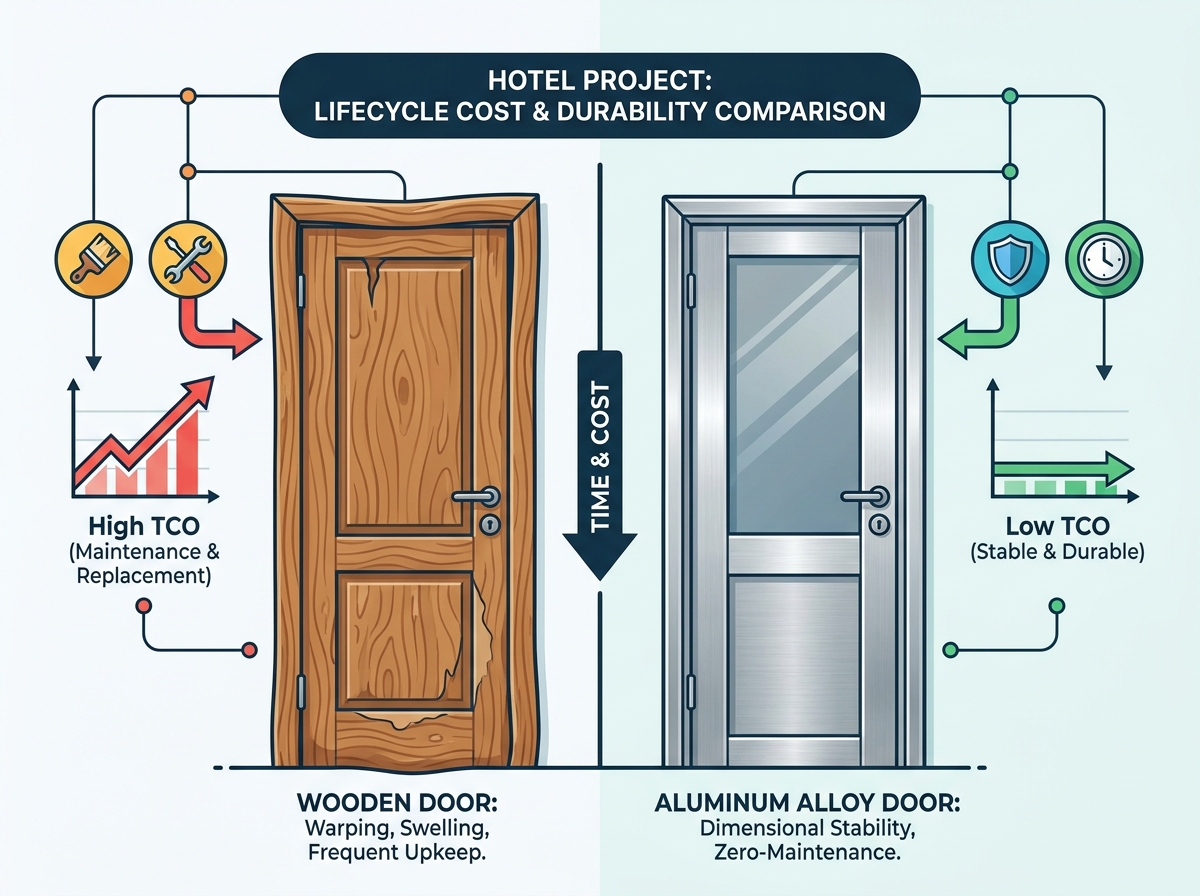
Durability & Stability: Aluminum eliminates the warping, swelling, and rotting inherent to wooden doors in high-humidity or high-traffic zones.
Total Cost of Ownership (TCO): Despite potentially similar upfront costs, aluminum yields significantly lower maintenance and replacement expenditures over a 10-15 year hospitality lifecycle.
Design Versatility: Advanced thermal transfer technologies allow aluminum to replicate the visual warmth of wood while accommodating large-format designs like a custom double opening door.
Sourcing Efficiency: Partnering directly with a vetted aluminum alloy door factory in China streamlines customization, reduces unit costs for bulk hotel projects, and ensures strict quality control.
Compare wood directly against commercial aluminum. Wood absorbs ambient moisture continuously. It swells during humid summers. HVAC systems dry the air heavily during winter. This rapid drying causes wood shrinkage. This endless cycle damages wooden frames permanently. Doors stick in the jamb. They fail to latch properly. Aluminum completely ignores these seasonal climate changes. It retains rigid structural integrity year-round. It never warps. It never bends out of shape.
Look closely at maintenance realities. Wood requires regular sanding. It needs repainting or re-staining every few years. Hotel staff constantly adjust sagging hinges on a wooden hotel swing door. Housekeeping carts bump the frames daily. Wood dents easily. The damage accumulates quickly. Aluminum offers highly durable anodized or powder-coated finishes. These specialized surfaces need zero maintenance. They resist deep scratches. They prevent UV fading. You simply wipe them clean using standard hospitality cleaning agents.
Consider lifecycle costing carefully. Frame your final choice balancing initial procurement (CAPEX) against ongoing maintenance (OPEX). Initial purchase prices might look quite similar on paper. However, wood drains operational budgets rapidly. You spend significant money on frequent repairs. You face early replacement cycles. A robust commercial aluminum door reduces long-term operational drag dramatically. It acts as a reliable financial asset. It preserves your maintenance capital for other pressing property needs.
Guest comfort relies entirely on quiet rooms. Acoustic insulation matters immensely. Commercial aluminum profiles easily match solid core wood. Engineers add specific thermal breaks inside the frames. They insert high-density acoustic infills into hollow chambers. These internal components trap sound waves efficiently. They easily achieve high Sound Transmission Class (STC) ratings. You can guarantee a quiet sleep environment. Traffic noise stays outside. Hallway chatter disappears.
Fire safety remains strictly non-negotiable. Wood burns quickly. Even chemically treated wood eventually fails under intense heat. Aluminum is naturally non-combustible. It meets stringent commercial building codes reliably. You face fewer compliance hurdles during municipal inspections. Fire-rated aluminum systems provide predictable safety boundaries. They compartmentalize smoke and flames effectively. They give guests crucial time during emergency evacuations.
Consider moisture resistance across different property zones. Hotels feature diverse micro-climates. Coastal properties battle constant salt spray. Bathrooms trap dense steam daily. Spa areas remain constantly humid. Wood absorbs this ambient moisture. It eventually rots. It hosts dangerous mold spores. Aluminum strictly outperforms wood here. It ignores humidity completely. It never rots. It never warps. It creates a highly sanitary barrier.
Performance Metric | Solid Wood Door | Aluminum Alloy Door |
|---|---|---|
Acoustic Insulation | Good (Requires exceptionally heavy solid core) | Excellent (Uses engineered acoustic infills) |
Fire Resistance | Combustible (Requires toxic chemical treatment) | Non-combustible (Delivers predictable safety ratings) |
Moisture Control | Poor (Highly prone to structural rot and mold) | Superior (Completely impervious to ambient moisture) |
Developers often worry about losing aesthetic warmth. They assume metal feels cold and sterile. Modern surface treatments solve this problem perfectly. Wood-grain sublimation is a highly popular technique. Factories bake a detailed wood-grain pattern directly into the powder coat. You get the visual warmth of natural timber. You keep the brute strength of industrial metal. This allows seamless interior design matching. Guests cannot tell the difference visually.
Format flexibility represents another massive structural advantage. Aluminum supports heavy architectural loads. It handles oversized glass panes easily. Wood struggles under immense glass weight. It bows under pressure. You might need a grand aluminum entrance door for the main lobby. Perhaps an expansive penthouse suite requires a custom double opening door. Aluminum handles these complex configurations flawlessly. The slim sightlines maximize natural light penetration.
Hardware compatibility dictates long-term performance. Hotels rely entirely on heavy-duty electronic locks. Access control systems require stable anchoring. Softwoods strip easily. Composite cores degrade over time. Screws pull out under heavy use. Heavy-duty aluminum extrusions grip hardware screws tightly. They provide superior anchoring for automatic closers and heavy hinges. Your security hardware stays completely secure for decades.
Every construction material carries specific implementation risks. You must plan carefully. Do not ignore potential site challenges.
First, consider installation tolerances. Aluminum frames demand precise rough openings. Wood forgives small measuring errors. Installers can plane a wooden edge on-site. You cannot shave down an aluminum frame.
Common Mistake: Framing contractors leaving irregular gaps around the rough opening.
Best Practice: Enforce strict laser-alignment protocols during the rough-in phase. Use precise shims to level the frame perfectly before final anchoring.
Second, address weight management properly. Aluminum doors carrying thick safety glass weigh significantly more than standard wooden doors. You cannot use basic residential hardware.
Select commercial-grade ball-bearing hinges rated for heavy continuous traffic.
Install concealed steel reinforcement plates inside the aluminum frame profile.
Verify floor structural load capacities if installing oversized lobby pivot systems.
Third, manage your project lead times transparently. Importing architectural materials introduces obvious scheduling risks. You must align overseas purchasing with your critical path timeline. Delaying orders causes massive site bottlenecks. You should finalize exact dimensions early in the framing stage. Order a physical mock-up for immediate architect approval. Release mass production orders in staggered batches. This matches the actual site build schedule seamlessly.
Finding a reliable manufacturing partner is critical. You must evaluate extrusion quality first. Ask direct questions about their raw material sourcing. Commercial hospitality projects demand 6063-T5 aluminum alloy. This specific alloy blends structural strength and architectural finish capabilities. Check their wall thickness standards carefully. Hotel environments require at least 2.0mm thickness for heavy traffic areas. Thinner residential profiles bend under commercial stress.
Certifications prove their manufacturing capability. Demand current ISO 9001 compliance documentation. Request verified acoustic testing reports from independent labs. Ask for international fire-rating certifications. Do not accept internal factory testing reports. Always rely on certified third-party laboratory results. This protects your liability.
Prototyping ensures absolute quality assurance. Establish a mandatory physical mock-up phase. You need a First Article Inspection (FAI). Inspect the physical product before authorizing mass production. Check the corner joints. Test the hardware operation. Inspect the finish quality under strong light. This critical step catches design flaws early.
Finally, verify their exact business structure. You need a direct manufacturer, not a middleman trading company. A genuine aluminum alloy door factory china controls the entire production line. They handle the raw extrusion. They manage the powder coating. They execute the final assembly under one roof. Ask for live video factory tours. Request raw material purchase records. This framework verifies their actual production capacity. It ensures you receive consistent quality across large bulk orders.
Wood always offers a traditional, nostalgic appeal. However, commercial hospitality projects demand significantly more. Engineered aluminum doors provide highly predictable performance. They offer unmatched scalability across large properties. They deliver the robust operational longevity required for modern hotel developments. They resist moisture effortlessly. They block ambient noise effectively. They secure the premises flawlessly against intrusion.
Procurement teams must take immediate, structured action. Define your exact STC requirements today. Document your fire-rating needs clearly for the manufacturer. Request comprehensive technical drawings from potential fabrication partners. Initiate the prototype mock-up process early. Partnering with a thoroughly vetted manufacturer guarantees a successful, durable installation. It ultimately elevates the final guest experience.
A: Yes. Manufacturers use advanced wood-grain thermal transfer processes. They apply a specialized powder coat base. Next, they bake a precise wood-grain film directly into the metal under high heat. This visually replicates exact wood species perfectly. You maintain the structural rigidity of metal while achieving authentic aesthetic warmth.
A: Initial costs vary based on custom finishes and glass choices. However, aluminum frequently costs less over the building's operational lifespan. Wood requires constant refinishing and frequent hardware adjustments. Aluminum needs near-zero maintenance. It boasts a significantly longer lifespan, preserving your ongoing operational budget.
A: They perform exceptionally well. Factories construct them using engineered multi-chamber profiles. They install proper acoustic seals around the entire perimeter. They also inject high-density sound-absorbing materials inside the frame core. These integrated systems easily meet the high STC ratings required for premium, quiet hospitality environments.
A: Production typically takes 30 to 45 days after you approve the initial prototype. You must also add 20 to 30 days for ocean freight transit. Customs clearance takes a few extra days. Project managers should factor in a complete 10 to 12 week procurement cycle to avoid delays.