E-mail: email@fusonwindoor.com | Tel: +86-189-2593-0732
 English
Views: 0 Author: Site Editor Publish Time: 2026-07-07 Origin: Site
Extreme weather puts immense pressure on structural building envelopes. Tropical regions constantly combine brutal UV exposure, heavy monsoons, and suffocating humidity. These harsh factors accelerate material degradation rapidly. Poor window choices quickly turn into disastrous structural failures. Standard material assumptions simply fail under these severe regional conditions. You must look far beyond generic spec sheets when planning a building project. Evaluators need to assess how these materials actually perform under continuous thermal stress and aggressive coastal salt exposure. We will break down exactly how aluminum and uPVC perform in tropical zones based on strict evidence. You will discover their definitive structural limits, long-term durability factors, and critical procurement risks. This comprehensive guide helps you secure the most resilient framing solutions for demanding environmental challenges. It provides clear insights to optimize your building's defense against extreme climates.
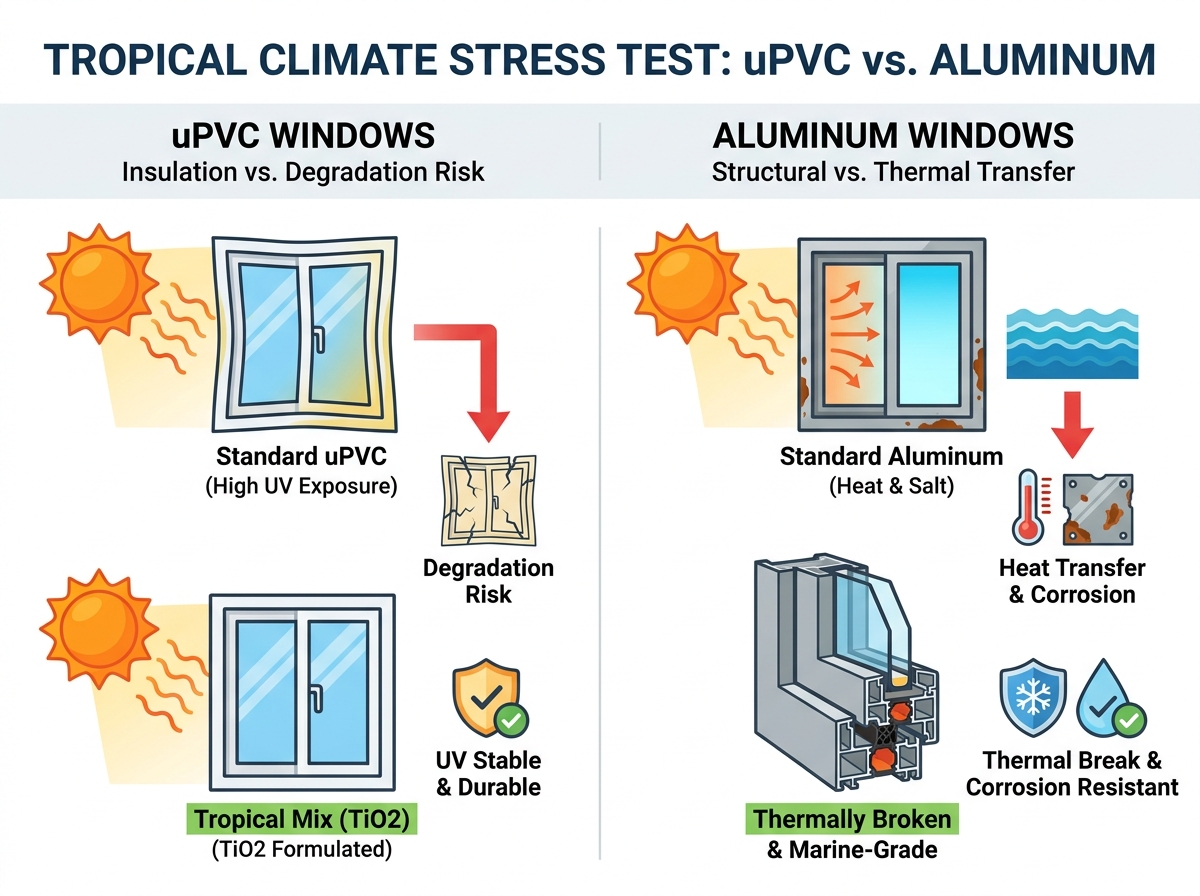
Standard uPVC degrades rapidly in tropical sun; buyers must verify high-UV "tropical mix" (TiO2) formulations.
Aluminum offers superior structural rigidity for large spans and cyclonic wind loads but requires specialized thermal breaks to prevent heat transfer.
Coastal proximity dictates the finish: untreated aluminum will corrode, requiring marine-grade anodizing or PVDF powder coatings.
Vendor selection is the ultimate fail-safe; evaluating a manufacturer's regional certifications and warranty limitations is more critical than the base material itself.
Tropical climates push building materials to their absolute physical limits. Standard architectural specifications often ignore the compounding effects of heat, humidity, and atmospheric salt. You must define strict performance criteria before evaluating framing options. This proactive approach prevents premature material failure.
High ambient heat creates a significant business problem for property developers. Intense ultraviolet radiation physically breaks down molecular bonds in standard framing materials. Prolonged exposure causes frames to warp, bow, or permanently discolor. The ideal tropical climate window must maintain dimensional stability during severe temperature fluctuations. If frames expand unevenly, they compromise the glass edge seals. Broken seals allow moisture intrusion and ruin indoor climate control.
Coastal proximity introduces airborne salt into the equation. Airborne salt acts as a highly corrosive agent. It aggressively attacks standard metals and internal moving parts. High humidity keeps this corrosive moisture trapped against the window surface. You must account for salt-spray exposure if your project sits within ten kilometers of a coastline. Ignoring this atmospheric reality guarantees rapid hardware deterioration.
Typhoon and cyclone zones demand exceptional structural rigidity. Heavy monsoons combine driving rain and extreme wind pressure. Windows face massive kinetic loads during these tropical storm events. Frames must resist bending under negative wind pressure. Multi-point locking mechanisms become necessary to ensure seal compression. You need robust mullions and reinforced transoms to prevent catastrophic blowouts during extreme weather.
Best Practices for Stress Testing:
Specify minimum Design Pressure (DP) ratings suitable for your exact coastal zone.
Demand water penetration resistance testing at high wind velocities.
Ensure all structural calculations account for maximum historical wind speeds.
Unplasticized Polyvinyl Chloride (uPVC) presents a complex profile for tropical applications. It excels in energy retention but faces severe vulnerabilities under direct sunlight. Understanding these limitations is critical for proper material specification.
uPVC inherently resists thermal transfer. The polymer structure blocks external heat from penetrating the indoor environment. This insulation mastery drastically reduces indoor cooling loads in hot climates. Multi-chambered frame designs trap air, creating an excellent thermal barrier. You achieve superior energy efficiency without needing complex thermal bridge interruptions. When evaluating any upvc window comparison, thermal performance remains its strongest advantage.
Standard European or North American uPVC formulations fail in tropical zones. They yellow, become brittle, and crack under extreme UV exposure. You must demand a verified "tropical blend" for hot climates. Quality uPVC extrusions utilize high levels of Titanium Dioxide (TiO2). This chemical additive reflects UV rays away from the polymer matrix. It acts as a permanent sunblock for the frame. Without adequate TiO2, the material lifespan drops dramatically.
High temperatures severely affect uPVC structural integrity. The plastic softens and sags under prolonged heat exposure. uPVC inherently lacks the tensile strength required for oversized architectural glazing. Manufacturers solve this by inserting galvanized steel reinforcement inside the hollow chambers. This steel adds necessary rigidity but increases overall weight. Poorly sealed joints allow humid air to reach this internal steel. Hidden rust points develop over time, ultimately swelling and cracking the plastic frame.
Property | Standard uPVC | Tropical Blend uPVC |
|---|---|---|
UV Resistance | Low (Yellows quickly) | High (TiO2 stabilized) |
Heat Deflection | Prone to sagging | Enhanced dimensional stability |
Internal Reinforcement | Often optional | Mandatory steel core |
Typical Lifespan | 5-10 years in tropics | 15-25 years in tropics |
Common uPVC Mistakes:
Accepting "UV-resistant" marketing claims without requesting actual TiO2 percentage documentation.
Specifying dark-colored uPVC frames, which absorb significantly more heat and warp faster.
Failing to verify internal steel reinforcement on windows wider than 1.5 meters.
Architects favor aluminum for its unmatched strength and sleek aesthetics. However, deploying standard aluminum in tropical climates invites severe heat transfer and corrosion problems. You must specify advanced engineering adaptations to utilize aluminum successfully.
Aluminum boasts an extraordinary strength-to-weight ratio. This property makes it the mandatory choice for oversized architectural glazing. You can achieve massive uninterrupted glass panels using exceptionally slim frame profiles. Heavy-duty applications, such as a large aluminum sliding window, rely on this structural rigidity. The metal frame handles intense wind loads without bending. It easily supports double or triple-glazed acoustic glass units required for urban tropical environments.
Standard aluminum conducts heat efficiently. In a tropical climate, an untreated aluminum frame acts as a massive radiator. It actively transfers blazing exterior heat directly into your air-conditioned space. Decision-makers must exclusively specify "thermally broken" aluminum systems. A thermal break involves inserting a reinforced polyamide plastic strut between the interior and exterior aluminum profiles. This structural barrier completely stops conductive heat gain. It transforms a highly conductive metal into an energy-efficient envelope component.
Coastal tropics destroy standard aluminum finishes rapidly. Basic powder coating blisters, flakes, and oxidizes when exposed to marine environments. You need a properly specified corrosion resistant window to survive coastal humidity. Industry standards dictate specific surface treatments for these zones. You must utilize AAMA 2605 compliant PVDF (Polyvinylidene Fluoride) coatings. Alternatively, specify deep marine-grade anodizing with a minimum thickness of 20 to 25 microns. These specialized treatments permanently seal the raw aluminum beneath, preventing pitting and white rust.
Evaluate the Span: Determine if your opening exceeds uPVC structural limits.
Verify the Break: Ensure the polyamide strut is at least 14.8mm wide for adequate thermal separation.
Audit the Coating: Check laboratory test reports for 10-year salt spray resistance.
Seal the Corners: Confirm corner joints use marine-grade epoxy injection to block moisture ingress.
Tropical climates punish building materials every single day. A window system is only as reliable as its ongoing maintenance reality. You must evaluate how long materials physically endure under constant environmental stress. We focus strictly on operational lifespans and the practical realities of maintaining functionality in humid, aggressive zones.
The physical lifespan of a window system dictates long-term structural security. uPVC generally provides a shorter functional lifespan under extreme UV exposure. Even high-quality tropical blends eventually experience plasticizer migration. This migration causes micro-cracking over decades of continuous heat exposure. Aluminum frames offer a significantly longer operational lifespan. Heavy-duty aluminum extrusions easily last over thirty years if properly treated. The metal itself does not degrade from UV light. As long as the marine-grade finish remains intact, the frame retains its original structural integrity indefinitely.
Operating mechanisms represent the weakest link in any tropical window installation. High humidity causes standard steel hinges, rollers, and locks to seize completely within months. Both frame types absolutely require 316-grade stainless steel internal hardware. This marine-grade steel resists atmospheric oxidation effectively. Maintenance routines differ greatly between materials. uPVC requires gentle wiping to prevent surface staining, but aggressive solvents will melt the plastic finish. Aluminum tracks require frequent clearing of dirt and salt debris. You must routinely lubricate aluminum sliding tracks with silicone-based sprays to prevent roller degradation.
Initial thermal performance means nothing if the materials degrade over time. Tropical windows must maintain their airtight seals across a ten-year operational span. uPVC frames risk losing their sealing capacity if thermal expansion causes permanent frame warping. Warped frames leave gaps between the sash and weatherstripping. Thermally broken aluminum maintains perfect dimensional stability. The rigid metal prevents frame distortion. This stability ensures weather seals remain tightly compressed year after year. Consequently, aluminum maintains its original thermal barrier effectiveness without degradation.
Essential Maintenance Tasks:
Flush bottom sill weep holes quarterly to prevent monsoon water overflow.
Apply UV-protectant spray to exposed EPDM rubber gaskets annually.
Inspect internal metal reinforcements for early signs of galvanic corrosion.
Sourcing materials for tropical climates requires intense vendor scrutiny. You cannot rely on generic marketing brochures. The manufacturing process dictates the final environmental resilience. A rigorous auditing approach prevents catastrophic installation failures.
You must rigorously audit any potential aluminum vs upvc window manufacturer before final selection. Demand absolute transparency regarding their raw material sourcing. For uPVC, require laboratory proof of their chemical compounding mix. Ensure the TiO2 content meets minimum tropical standards. For aluminum, verify the specific alloy grade being extruded. High-quality architectural applications demand 6063-T5 or 6060-T66 aluminum alloys. These specific grades provide optimal tensile strength and anodizing compatibility. Reject any manufacturer hiding their base material specifications.
Manufacturer warranties often contain hidden exclusions tailored against tropical buyers. Many international brands quietly void their guarantees if windows are installed within five to ten kilometers of saltwater. They classify this proximity as a "severe corrosive environment." You must read the fine print regarding coastal proximity. Buyers must negotiate and secure coastal-specific warranty terms in writing. Ensure the warranty covers both the frame finish and the internal locking hardware against salt-induced corrosion.
Never accept internal company testing as proof of performance. You must shortlist vendors based exclusively on verified third-party testing standards. Look for certifications covering air leakage, dynamic water penetration, and structural wind loads.
Critical Certifications to Verify:
AS2047: Australian standard highly relevant for extreme weather and structural deflection.
AAMA Standards: American guidelines dictating strict coastal finish requirements (AAMA 2605).
CE Markings: European conformity indicating compliance with severe climate performance metrics.
NFRC Ratings: Independent verification of thermal transmittance and solar heat gain coefficients.
Choosing between aluminum and uPVC in tropical climates dictates the long-term resilience of your building envelope. Standard materials fail quickly under intense UV radiation and coastal humidity. Evaluators must prioritize advanced engineering over basic aesthetic appeal to ensure environmental survival.
Our final verdict matrix offers clear guidance. uPVC remains highly effective for standard-sized residential applications, provided it utilizes a certified tropical TiO2 blend. It naturally blocks heat without complex thermal breaks. Conversely, aluminum is absolutely non-negotiable for large architectural spans and extreme wind-load zones. However, you must specify deep marine coatings and integrated polyamide thermal breaks to make aluminum viable in the tropics.
Your next steps require immediate action. Request localized sample warranties from short-listed vendors to check for coastal exclusion clauses. Ask suppliers to provide corner-cut cross-sections of their frames. You can physically inspect the thermal breaks and internal steel reinforcements. Finally, mandate 316-grade stainless steel for all moving hardware components. Securing these specific details guarantees your windows will endure the harshest tropical conditions.
A: Yes, standard uPVC turns yellow and becomes brittle under intense UV exposure. Cheap European-spec uPVC lacks necessary chemical stabilizers. You must specify a UV-stabilized "tropical blend" containing high levels of Titanium Dioxide (TiO2). This additive reflects ultraviolet radiation, preventing discoloration and structural degradation in hot climates.
A: No. Standard powder coating fails rapidly in coastal environments. Saltwater humidity penetrates basic coatings, causing the aluminum to blister, pit, and oxidize. Coastal homes strictly require marine-grade surface treatments. You must use AAMA 2605 compliant PVDF coatings or deep anodizing (minimum 20 microns) to seal the metal.
A: uPVC generally requires less superficial maintenance since it does not corrode. You only need to wipe the frames with mild soap. Aluminum requires more diligent maintenance in high humidity. You must regularly clean salt debris from sliding tracks and frequently lubricate the internal hardware to prevent seizing.
A: Yes, but only if properly engineered. Standard aluminum conducts exterior heat rapidly into the building. To achieve energy efficiency, you must specify "thermally broken" aluminum. This process inserts a rigid polyamide plastic barrier inside the frame. The barrier completely stops conductive heat gain from entering the room.