E-mail: email@fusonwindoor.com | Tel: +86-189-2593-0732
 English
Views: 0 Author: Site Editor Publish Time: 2026-07-15 Origin: Site
Sourcing building materials overseas can dramatically transform your project profitability. Many contractors, developers, and distributors turn to international markets to improve their margins. However, importing materials directly carries distinct financial and operational risks. You face potential hurdles like strict non-compliance, catastrophic sizing errors, and severe transit damage. These pitfalls can easily derail lucrative construction projects. They can also destroy your upfront savings completely.
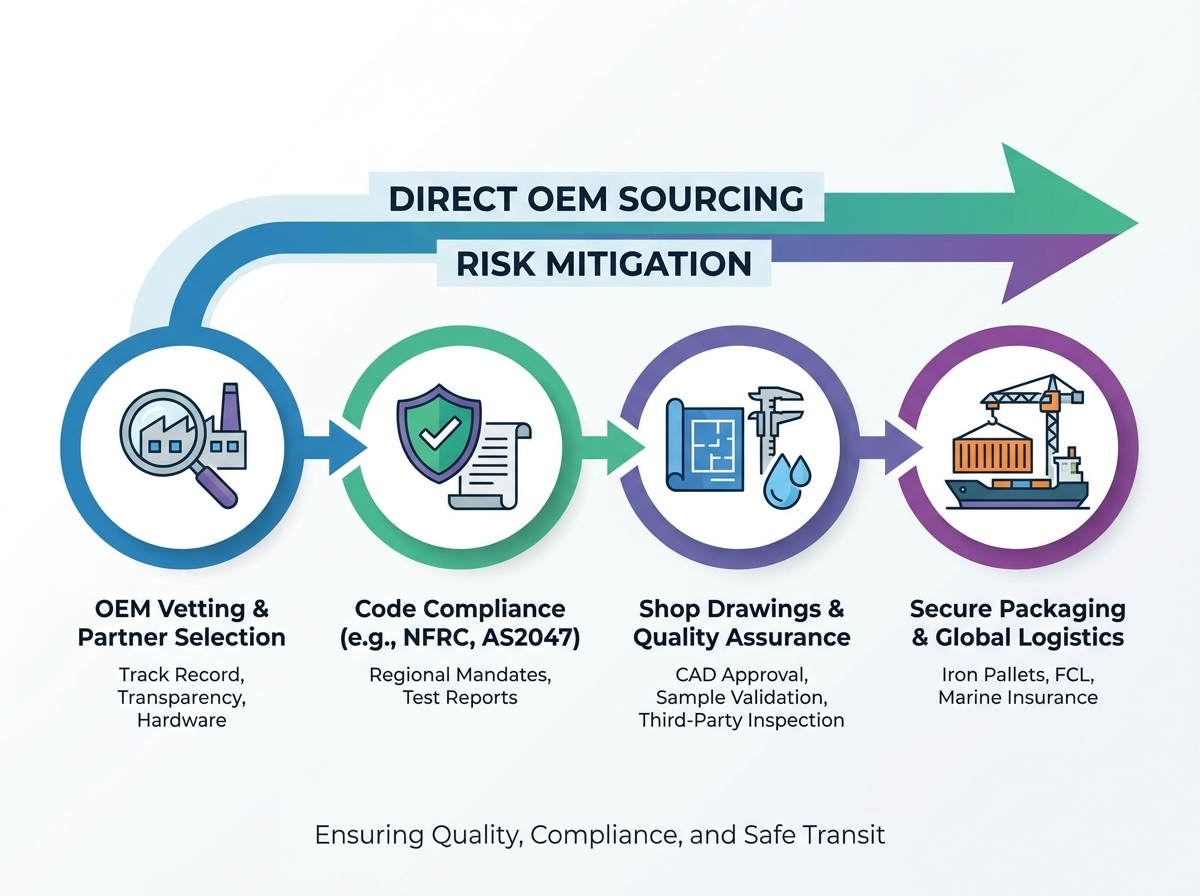
Many seasoned builders consider direct importing a highly lucrative strategy. They bypass local markups entirely. You gain total control over the manufacturing timeline. You can dictate the exact specifications for your project. To navigate this complex landscape safely, you need a highly reliable strategy. This guide provides a rigorous, step-by-step evaluation framework. You will learn exactly how to source, vet, and safely import commercial or residential units. We show you how to navigate the supply chain efficiently. Our goal is to protect your project timelines. We also want to guarantee strict building compliance from day one.
Verify Certifications First: A valid OEM must provide verifiable test reports for your specific region (e.g., NFRC for North America, AS2047 for Australia) before any technical discussions begin.
Factory Over Trader: Partnering directly with an aluminum window importer china oem ensures control over profile thickness, hardware selection, and warranty execution.
Packaging is Critical: Glass fragility dictates that logistical success relies heavily on specific packaging standards (iron pallets, sealed plywood) and prioritizing full container loads.
Mandate Shop Drawings: Never initiate production without mutually signed, exhaustive shop drawings detailing every extrusion, thermal break, and hardware placement.
Foshan, Guangdong operates as the undisputed epicenter for aluminum extrusions globally. It hosts a mature, deeply consolidated manufacturing network. This regional advantage gives buyers direct access to complete supply chains. You will find glass processors, hardware suppliers, and extrusion facilities all within a few miles. This tight cluster reduces domestic transportation times. It also speeds up the prototyping phase significantly.
When exploring this market, you must distinguish between trading companies and genuine manufacturers. Trading companies often present lower minimum order quantities. They act as middlemen between you and the factory. This setup masks the true origin of your products completely. It makes quality control incredibly difficult to manage. Handling warranty claims becomes almost impossible later. They rarely employ dedicated factory engineers. They simply pass messages back and forth.
Conversely, genuine OEMs offer massive advantages for professional buyers. You get direct technical communication with the actual engineers. You can request specific structural customizations easily. They also provide scalable production lines suited for an oem window export strategy. To evaluate a china aluminum window supplier properly, look beyond domestic capabilities. Your ideal partner must have specialized export experience targeting your specific country. They need to understand your local market nuances. They must know how your specific building codes operate.
Vetting suppliers requires a strict, multi-layered approach. You must evaluate candidates across several critical dimensions to ensure long-term reliability.
Export Track Record
Request actual bills of lading from the factory directly. Ask for recent project references located in your target market. These documents verify their marketing claims accurately. They prove the supplier actually exports to your region successfully. You can often contact these past clients. Ask them about their delivery experience. Inquire about any post-installation defects they encountered.
Material Transparency
Assess how openly they discuss technical specifications. A reliable aluminum window importer china oem partner will explicitly specify aluminum profile thickness. Residential builds usually require a minimum of 1.4mm thickness. Commercial projects demand 2.0mm or higher for structural integrity. They should also mandate premium thermal break materials. Ask them to confirm the use of PA66 nylon. Avoid factories using cheap PVC thermal breaks. PVC degrades quickly under intense UV exposure.
Hardware Supply Chain
Avoid factories pushing generic, unbranded hardware components. Reliable OEMs integrate internationally recognized hardware seamlessly. Look for established European names like HOPPE, Roto, or Siegenia. They may also offer premium domestic equivalents like Kin Long. High-quality hardware prevents premature locking failures. It ensures smooth operation for decades.
Watch out for major red flags during your search. Beware of suppliers offering prices significantly below the market average. Low prices usually indicate compromised profile thickness. They might use recycled aluminum instead of virgin ingots. They might also install substandard, poorly tempered glass. These shortcuts compromise the structural integrity of your build entirely.
Vetting Dimension | Genuine OEM Indicators | Red Flag Warnings |
|---|---|---|
Export History | Provides verified bills of lading for your region | Only shows domestic project portfolios |
Material Specs | Specifies 1.4mm+ thickness and PA66 thermal breaks | Vague descriptions; uses recycled aluminum |
Hardware Supply | Partners with HOPPE, Roto, Siegenia, Kin Long | Uses generic or unbranded locking mechanisms |
Pricing Model | Transparent quotes matching industry averages | Drastically cheaper than competing factory quotes |
Building codes act as the ultimate filter for any overseas purchase. You must understand the specific regional mandates governing your project area thoroughly.
North American builds require strict NFRC ratings. You must prove the exact U-factor and Solar Heat Gain Coefficient values. AAMA certification is also highly recommended for commercial applications. In Australia and New Zealand, builders face rigorous environmental standards. Strict adherence to AS2047 for weather performance is non-negotiable. You must also meet AS/NZS 2208 for safety glass regulations. European projects require valid CE marking. They also demand full REACH compliance for chemical safety standards.
Ignoring these regulations introduces massive implementation risk. Customs officials can seize your shipments at the port. Local building inspectors will absolutely reject non-compliant materials on site. This forces you to reorder everything locally at a premium. It destroys your project schedule completely.
Take actionable steps early in the sourcing process. Demand raw test reports from the factory directly. Cross-reference the supplier's name actively. Check the issuing testing laboratory's public database yourself. Never accept modified PDFs or blurry screenshots as definitive proof. Reputable labs keep online registries. You can verify certificate numbers in seconds.
Managing production requires tight controls before any manufacturing begins. The pre-production workflow sets the technical foundation for your entire order.
Every custom import window demands a highly detailed CAD shop drawing. This document must show exact dimensions and precise opening directions. It should outline the exact glass makeup clearly. For example, specify a 5mm+12A+5mm Low-E configuration. It must also pinpoint all hardware placements accurately. Both parties must sign these drawings physically or digitally. This creates a binding technical agreement.
Never authorize mass production immediately based on drawings alone. Pay for a fully functional corner sample first. You might even request a complete prototype unit shipped to your office. This step validates their workmanship physically. It lets you test the locking mechanisms firsthand.
Implement robust Quality Assurance (QA) protocols early in the contract.
Define strict acceptable tolerances for all frame dimensions. Usually, a +/- 1mm tolerance is standard.
Require continuous video and photo evidence during the production phase.
Request visual proof of water penetration tests on the factory floor.
Demand air leakage test results before packaging begins.
Finally, hire an independent QA agency for peace of mind. Firms like SGS or TÜV offer excellent pre-shipment inspections. They act as your eyes on the factory floor. They will scrutinize glass integrity thoroughly. They check for frame scratches and verify all hardware functions perfectly. They send you a detailed report before you pay the final balance.
Shipping fragile glass across oceans demands flawless logistical execution. Protecting the cargo is your absolute highest priority here. Standard cardboard packaging is completely insufficient for international transit.
Require heavy-duty iron pallets, often called stillages. Alternatively, demand fully enclosed, fumigated plywood crates. The factory must place EPE foam separation blocks between every single frame. This prevents metal-on-metal scratching. It also absorbs intense vibrations during rough ocean swells.
Consolidating a container load window shipment is highly recommended. You should aim for a dedicated 20ft or 40ft HQ container. Shipping Less than Container Load (LCL) significantly increases your damage risks. Consolidation hubs use forklifts aggressively to move mixed freight. The extreme weight and fragility of glass make LCL shipments highly vulnerable. Other cargo might crash into your fragile crates.
Choose your shipping terms, or Incoterms, carefully before signing.
FOB (Free on Board): This works best for buyers using their own freight forwarders. It gives you maximum control over shipping costs and transit timelines. You control the logistics once the goods hit the departure port.
CIF/DDP: These terms might seem easier initially. The factory handles the shipping arrangements. However, they often contain hidden destination port fees. You might face unexpected handling charges upon arrival.
Always mandate comprehensive marine insurance for your cargo. Request Institute Cargo Clauses 'A' coverage specifically. This specific tier protects you against catastrophic glass breakage during ocean transit. It provides the broadest coverage available for international sea freight. Do not settle for basic 'C' clauses. They only cover major vessel catastrophes.
Importing building materials is not just about finding the cheapest unit price. It is about securing a compliant, technically capable OEM partner. Your factory must understand international logistics and regional building codes intimately.
Follow these concrete next steps to launch your sourcing process:
Audit three to five distinct factories using the vetting dimensions outlined above.
Request and verify official compliance certificates for your specific regional building codes.
Order a paid functional sample to evaluate their communication speed and build quality.
Finalize your shipping strategy by securing a reliable freight forwarder and comprehensive cargo insurance.
A: Buyers typically save 30-50% on commercial volumes. However, you must factor in ocean shipping, import duties, and local transport costs. Calculate these additional expenses thoroughly before finalizing your projected return on investment.
A: The claim process depends on your Incoterms. If you ship FOB with CIF insurance, you file the claim with the insurer using clear unboxing evidence. Reputable OEMs will manufacture replacement panels at cost or for free on future shipments.
A: A realistic timeline spans several months. Expect 1-2 weeks for detailed drawing approval. Production usually takes 25-35 days. Ocean transit requires an additional 20-40 days. This depends heavily on your specific destination port and customs clearance speed.
A: Yes. Standard export manufacturers routinely supply premium glazing options. They offer argon-filled, double or triple-pane Low-E tempered glass. They can tailor these specific insulating makeups to meet your exact regional climate zone requirements perfectly.